
 ,
Fabien Betene Ebanda,
Yakum Reneta Nafu,
Armel Edwige Mewoli,
Tido Tiwa Stanislas
,
Fabien Betene Ebanda,
Yakum Reneta Nafu,
Armel Edwige Mewoli,
Tido Tiwa Stanislas
The impregnation of wood in fiber cement boards aims to replace traditional ceiling boards, which are prone to moisture damage over time. This study explores a modified hornification process involving fiber treatment with a solution of hexamine and gallic acid (H/G method) compared to a conventional hornification method (H method), where fibers are soaked in tap water. The objective is to evaluate the influence of this modified process on the morphological, physicochemical, and mechanical properties of Urena lobata (UL) bast fibers from the Littoral region of Cameroon. The fibers underwent four wet-dry treatment cycles using both the H/G and H methods. Results revealed significant reductions in water and moisture absorption compared to untreated (UT) fibers. Water absorption decreased from 227.79±0.05% (UT) to 200.34±0.05% (H) and 130.37±0.03% (H/G), while moisture absorption reduced from 9.286% (UT) to 7.03% (H) and 5.854% (H/G). Additionally, an increase in fiber density was observed, rising from 1.72±0.012 g/cm³ (UT) to 1.78±0.012 g/cm³ (H) and 1.87±0.04 g/cm³ (H/G), attributed to the infiltration of hexamine and gallic acid into the fiber cells. Mechanical performance was assessed through flexural and compressive tests after 7, 14, and 28 days of curing. Both elastic modulus and compressive strength improved progressively from untreated fibers through the H method to the H/G method, with increases of 20% and 30%, respectively. These findings demonstrate that the hexamine and gallic acid treatment enhances the effectiveness of the hornification process, significantly improving the water resistance and mechanical performance of the treated fibers.
| Published in | International Journal of Materials Science and Applications (Volume 14, Issue 4) |
| DOI | 10.11648/j.ijmsa.20251404.15 |
| Page(s) | 154-171 |
| Creative Commons |
This is an Open Access article, distributed under the terms of the Creative Commons Attribution 4.0 International License (http://creativecommons.org/licenses/by/4.0/), which permits unrestricted use, distribution and reproduction in any medium or format, provided the original work is properly cited. |
| Copyright |
Copyright © The Author(s), 2025. Published by Science Publishing Group |
Urena Lobata, Hexamine, Gallic acid, Conventional Hornification, Modified Hornification Treatment
Cement to sand | Water to cement ratio | Coir fibers (by weight) | Fiber |
|---|---|---|---|
3:1 | 0.50 | 0% | H. H/G, H. HO2, and untreated |
2.85:1 | 0.50 | 1% | H. H/G, H. HO2, and untreated |
2.80:1 | 0.50 | 1.5% | H. H/G, H. HO2, and untreated |
2.70:1 | 0.50 | 2.5% | H. H/G, H. HO2, and untreated |
Fibers | Cellulose (wt%) | Hemicellulose (wt%) | Lignin (wt%) | Pectin (wt%) | Extractives (wt%) | Ash content (wt%) | References |
|---|---|---|---|---|---|---|---|
Flax | 60 - 81 | 18.6 - 20.6 | 14 - 19 | 2.3 | - | - | ( [24 -26]) |
Hemp | 70 - 74 | 17.9 - 22.4 | 3.7 - 5.7 | 0.9 | - | - | [25] |
Eucalyptus bleached kraft | 89 | - | 0.5 | - | - | - | [31] |
Urena Lobata | 73.2 | 10.6 | 16.2 | - | - | - | [14] |
Coconut | 36 - 43 | 0.15 - 14.7 | 41 - 45 | 3 - 4 | - | - | ( [25, 26] ) |
RC | 65.15 | 7.42 | 16.2 | 3.45 | 5.22 | 0.42 | [32] |
OPEFBst | 35 | 23 | 28 | - | 14 | 10.58 | [33] |
UL Untreated | 71.2 | 10.2 | 14.6 | 1.2 | 0.46 | 2.34 | Present study |
UL H (Conventional) | 70.12 | 11.43 | 13.2 | 1.3 | 1.66 | 2.29 | Present study |
UL H. H/G | 74.14 | 11.59 | 13.4 | 0.5 | 0.36 | 0.01 | Present study |
Fiber | Moisture content (%) | Density (g cm-3) | Water absorption (%) | References |
|---|---|---|---|---|
Flax | 12 | 1.5 | 136 25 | [40, 41] |
Hemp | 6.2 - 12 | 1.15 1.45 | - | [34, 44] |
Jute | 12 - 13.7 | 1.3 - 1.41 | 281 | ( [34, 40, 41] ) |
Urena Lobata | 10.5 | 0.23463 | 228.58 | [38] |
Urena Lobata | - | 1.72 | - | [14] |
RC | 9.37 | 0.757 0.08 | 198.17 20.23 | [45] |
Sida Stipulate | 8.6 | 0.20114 | 220.95 | [38] |
UL Untreated | 9.286 | 1.72±0.012 | 227.79±0.05 | Present study |
UL H (Conventional) | 7.03 | 1.78±0.012 | 200.34±0.05 | Present study |
UL H. H/G | 5.854 | 1.870.04 | 130.37±0.03 | Present study |
UL UNTREATED (cm -1) | UL H. H (cm -1) | UL H. H+G ADDITIVE (cm -1) | ASSIGNMENT | REFERENCE |
|---|---|---|---|---|
3600-3200 | 3600-3200 | 3600-3200 | Stretching of OH bonds (cellulose -hemicellulose) | [46, 48] |
2950-2900 | 2950-2900 | 2950-2900 | Asymmetry vibration of VAS CH2 characteristics of hemicellulose cellulose and lignin | |
1600 | 1600 | 1600 | Aromatic ring vibration | [5 0, 51] |
1506 | 1506 | 1506 | Symmetrical stretching of C=C of lignin | [32, 59] |
1455 | 1455 | 1455 | C-H deformation (lignin) and CH 2 symmetric bending (cellulose) | [5 2] |
1428-1417 | 1428-1417 | 1428-1417 | Relates to the crystalline structure of cellulose | [5 3] |
1200 | 1200 | 1200 | CH2 wagging and it is characteristic of crystalline cellulose | [5 4] |
1107-1090 | 1107-1090 | 1107-1090 | C-O-C asymmetric stretching for carbohydrate and cellulose | [5 3] |
1040 | 1040 | 1040 | attributed to vibrations of C-O bonds | [56] |
896 | 896 | 897 | Symmetric stretching of the C-H and O-H bonds of cellulose. | [32, 5 2] |
H/G | Hexamine gallic acid |
H | Conventional method |
UL | Urena Lobata |
UT | Untreated |
SEM | Scanning Electron Microscope |
EDX | Energy Dispersive X-ray Spectroscopy |
XRD | X-ray Diffraction |
TGA | Thermogravimetry Analysis |
FTIR-ATR | Fourier Transform Infrared Spectroscopy-Attenuated Total Reflectance |
| [1] | Vinod, A., Sanjay, M. R., & Siengchin, S. (2023). Recently explored natural cellulosic plant fibers 2018--2022: A potential raw material resource for lightweight composites. Industrial Crops and Products, 192, 116099. |
| [2] | Mendes, S., Hugen, L. N., Dos Santos, R. D., Toledo Filho, R. D., & Ferreira, S. R. (2021). Influence of water amount and immersion time on the sisal fibers hornification process. Journal of Natural Fibers, 18(11), 1712-1721. |
| [3] | Oliveira Filho, E. G. de, Luz, F. S. da, Fujiyama, R. T., Silva, A. C. R. da, Candido, V. S., & Monteiro, S. N. (2020). Effect of chemical treatment and length of raffia fiber (Raphia vinifera) on mechanical stiffening of polyester composites. Polymers, 12(12), 2899. |
| [4] | Mejia-Ballesteros, J. E., Rodier, L., Filomeno, R., Savastano Jr, H., Fiorelli, J., & Rojas, M. F. (2021). Influence of the fiber treatment and matrix modification on the durability of eucalyptus fiber reinforced composites. Cement and Concrete Composites, 124, 104280. |
| [5] | Tido Tiwa Stanislas, Yakum R. Nafu, N. R. Sikame Tagne, Assia A. Mohamat, P. W. Huisken Mejouyo, Josepha F. Tendo & Ebenezer Njeugna (2023) Impact of wet-drying Treatment of Raffia and Okra Fibres on Their Morphological, Physicochemical and Mechanical Properties, Journal of Natural Fibers, 20: 1, 2176012, |
| [6] | da Luz, F. S., Candido, V. S., Da Silva, A. C. R., & Monteiro, S. N. (2018). Thermal behavior of polyester composites reinforced with green sugarcane bagasse fiber. Jom, 70, 1965-1971. |
| [7] | Ballesteros, J. E. M., Mármol, G., Filomeno, R., Rodier, L., Savastano Jr, H., & Fiorelli, J. (2019). Synergic effect of fiber and matrix treatments for vegetable fiber reinforced cement of improved performance. Construction and Building Materials, 205, 52-60. |
| [8] | Claramunt, J., Ardanuy, M., Garc\’\ia-Hortal, J. A., & Tolêdo Filho, R. D. (2011). The hornification of vegetable fibers to improve the durability of cement mortar composites. Cement and Concrete Composites, 33(5), 586-595. |
| [9] | Khorami M and Ganjian E. Comparing flexural behaviour of fibre-cement composites reinforced bagasse: Wheat and eucalyptus. Construction and Building Materials, 2011; 25(9): p. 3661-3667. Joshi SV, et al., Are natural fiber composites environmentally superior to glass fiber reinforced composites? Composites Part A: Applied Science and Manufacturing, 2004; 35(3): p. 371-376. |
| [10] | Tonoli, G. H. D., Rodrigues Filho, U. P., Savastano Jr, H., Bras, J., Belgacem, M. N., & Lahr, F. A. R. (2009). Cellulose modified fibres in cement based composites. Composites Part A: Applied Science and Manufacturing, 40(12), 2046-2053. |
| [11] | G. Tondi, M. F. Thevenon, B. Mies, G. Standfest, A. Petutschnigg • S. Wieland (2013) Impregnation of Scots pine and beech with tannin solutions: effect of viscosity and wood anatomy in wood infiltration Wood Sci Technol (2013) 47: 615-626 |
| [12] | Ferreira, S. R., de Andrade Silva, F., Lima, P. R. L., & Toledo Filho, R. D. (2015). Effect of fiber treatments on the sisal fiber properties and fiber--matrix bond in cement based systems. Construction and Building Materials, 101, 730-740. |
| [13] | Letková, E., Letko, M., & Vrška, M. (2011). Influence of recycling and temperature on the swelling ability of paper. Chemical Papers, 65(6), 822-828. |
| [14] | Kengoh, J. B., Peter Etape, E., Victorine Namondo, B., Foba-Tendo, J., Nafu, Y. R., & Fabien, B. E. (2021). Influence of Urena lobata Fibre Treatment on Mechanical Performance Development in Hybrid Urena lobata: Fibre/Gypsum Plaster Composites. Advances in Materials Science and Engineering, 2021. |
| [15] | Khan, G. M. A., Shaheruzzaman, M., Rahman, M. H., Razzaque, S. M. A., Islam, M. S., & Alam, M. S. (2009). Surface modification of okra bast fiber and its physico-chemical characteristics. Fibers and Polymers, 10(1), 65. |
| [16] | Stanislas, T. T., Tendo, J. F., Ojo, E. B., Ngasoh, O. F., Onwualu, P. A., Njeugna, E., & Junior, H. S. (2020). Production and Characterization of Pulp and Nanofibrillated Cellulose from Selected Tropical Plants. Journal of Natural Fibers, 00(00), 1-17. |
| [17] | Nkapleweh, A. D., Tendo, J. F., Ebanda, F. B., Noah, P. M. A., Mewoli, A. E., & Stanislas, T. T. (2022). Physico-Chemical and Mechanical Characterization of Triumfetta Pentandra Bast Fiber from the Equatorial Region of Cameroon as a Potential Reinforcement of Polymer Composites. Journal of Natural Fibers, 1-14. |
| [18] | Nadlene, R., Sapuan, S. M., Jawaid, M., Ishak, M. R., & Yusriah, L. (2015). Material characterization of roselle fibre (Hibiscus sabdariffa L.) as potential reinforcement material for polymer composites. Fibres \& Textiles in Eastern Europe, 6 (114), 23-30. |
| [19] | Buschle-Diller, G., & Zeronian, S. H. (1992). Enhancing the reactivity and strength of cotton fibers. Journal of Applied Polymer Science, 45(6), 967-979. |
| [20] | Bishweka Biryondeke, C., Ngapgue, F. and Olembe Musangi, G. (2016) Study of Water Absorption Coefficient of Goma’s Volcanic Aggregates and Its Influence in Formulating Concrete. International Journal of Innovation and Applied Studies, 15, 141-152. |
| [21] | Agamveer Singh, Jaspreet Singh, Shaurya Ajay Properties of Fiber Cement Boards for Building Partitions. International Journal of Applied Engineering Research ISSN 0973-4562 Volume 13, Number 10 (2018) pp. 8486-8489 © Research India Publications. |
| [22] |
Yi Jia, Renda Zhao, Ping Liao, et al. Experimental study on mix proportion of fiber reinforced cementitious composites. Cite as: AIP Conference Proceedings 1890, 020002 (2017);
https://doi.org/10.1063/1.5005180 Published Online: 05 October 2017. |
| [23] | ACI (2003) 213 R-87, Guide for structural lightweight aggregate concrete. Michigan: American Concrete Institute. |
| [24] | Gurunathan, T., Mohanty, S., & Nayak, S. K. (2015). A review of the recent developments in biocomposites based on natural fibres and their application perspectives. Composites Part A: Applied Science and Manufacturing, 77, 1-25. |
| [25] | Jeyapragash, R., Srinivasan, V., & Sathiyamurthy, S. (2020). Mechanical properties of natural fiber/particulate reinforced epoxy composites--A review of the literature. Materials Today: Proceedings, 22, 1223-1227. |
| [26] | Pereira, P. H. F., Rosa, M. de F., Cioffi, M. O. H., Benini, K. C. C. de C., Milanese, A. C., Voorwald, H. J. C., & Mulinari, D. R. (2015). Vegetal fibers in polymeric composites: a review. Pol{\’\i}meros, 25, 9-22. |
| [27] | Hassan, M., et al. (2023). "Advances in Chemical Treatments of Lignocellulosic Fibers for Enhanced Composite Performance." Journal of Renewable Materials, 11(3), 456-469. |
| [28] | Kaur, P., et al. (2022). "Comparative Analysis of Natural Fiber Compositions and Their Impact on Composite Strength." Materials Today: Proceedings, 67, 1892-1901. |
| [29] | Mehra, M., et al. (2023). "Impact of Surface Roughness on Fiber-Matrix Adhesion in Natural Composites." Journal of Polymer Interfaces, 12(3), 211-224. |
| [30] | Silva, A. P., et al. (2022). "Effect of Chemical Treatments on Thermal and Mechanical Properties of Natural Fibers." Journal of Natural Fibers, 19(5), 732-748. |
| [31] | Agopyan, V., Savastano Jr, H., John, V. M., & Cincotto, M. A. (2005). Developments on vegetable fibre--cement based materials in São Paulo, Brazil: an overview. Cement and Concrete Composites, 27(5), 527-536. |
| [32] | Betene, A. D. O., Betene, F. E., Marto\"\ia, F., Dumont, P. J. J., Atangana, A., & Noah, P. M. A. (2020). Physico-Chemical and Thermal Characterization of Some Lignocellulosic Fibres: Ananas comosus (AC), Neuropeltis acuminatas (NA) and Rhecktophyllum camerunense (RC). Journal of Minerals and Materials Characterization and Engineering, 8(4), 205-222. |
| [33] | Beckley, V. N., Josepha, F.-T., Ekane, P. E., & Rui, W. M. K. (2018). Potential of blended biomass feedstock from some species of raffia palm (Raffia farinifera, Raffia hookeri and Raffia vinifera) and Oil Palm Empty Fruit Bunch (OPEFB) from Cameroon. African Journal of Pure and Applied Chemistry, 12(4), 25-33. |
| [34] | Asim, M., Abdan, K., Jawaid, M., Nasir, M., Dashtizadeh, Z., Ishak, M. R., & Hoque, M. E. (2015). A review on pineapple leaves fibre and its composites. International Journal of Polymer Science, 2015. |
| [35] | Uddin, N., Miah, S., Abdul, M., Jalil, M. A., Islam, M., & Ayesha, S. (2017). A review on extraction, characterization and application of pineapple leaf fiber (palf) in textiles and other fields. International Journal of Advanced Research, 5, 112-116. |
| [36] | Silva, A. P., et al. (2023). "FTIR Analysis of Natural Fiber Modifications for Enhanced Composite Applications." Advanced Materials Research, 18(2), 145-159. |
| [37] | Ali, M., et al. (2022). "Advances in Hydrophobic Treatments for Reducing Moisture Content in Lignocellulosic Fibers." Materials Science Forum, 1250, 467-480. |
| [38] | Alphousseyni Ghabo, Seckou Bodian, and El hadji Dieng (2024) Evaluation of the Physical and Thermal Properties of Fibers Extracted from the Trunks of Urena Lobata and SIDA Stipulata Plants Current Journal of Applied Science and Technology Volume 43, Issue 4, Page 84-92, 2024; Article no. CJAST.114789 ISSN: 2457-1024. |
| [39] | Mewoli, A. E., Segovia, C., Ebanda, F. B., Ateba, A., Noah, P. M. A., Ndiwe, B., & Njom, A. E. (2020b). Physical-chemical and mechanical characterization of the bast fibers of Triumfetta cordifolia A. rich. from the equatorial region of Cameroon. Journal of Minerals and Materials Characterization and Engineering, 8(4), 163-176. |
| [40] | Baley, C., Le Duigou, A., Bourmaud, A., & Davies, P. (2012). Influence of drying on the mechanical behaviour of flax fibres and their unidirectional composites. Composites Part A: Applied Science and Manufacturing, 43(8), 1226-1233. |
| [41] | Page, J. (2017). Formulation et caractérisation d’un composite cimentaire biofibré pour des procédés de construction préfabriquée. Normandie Université. |
| [42] | Chen, Y., Wan, J., Zhang, X., Ma, Y., & Wang, Y. (2012). Effect of beating on recycled properties of unbleached eucalyptus cellulose fiber. Carbohydrate Polymers, 87(1), 730-736. |
| [43] | Köhnke, T., Lund, K., Brelid, H., & Westman, G. (2010). Kraft pulp hornification: A closer look at the preventive effect gained by glucuronoxylan adsorption. Carbohydrate Polymers, 81(2), 226-233. |
| [44] | Brahimi, H Bokhari-Taieb, D E Aizi, A Bouhafsoun, K Hachem, R Mezemaze, M Kaid-Harche, and others. 2019. “Extraction and Analysis of Polysaccharides from Tissues of Retama Monosperma Branches.” South Asian Journal of Experimental Biology 9 (5): 214-21. |
| [45] | Ntenga, R. (2007). Modélisation multi-échelle et caractérisation de l’anisotropie élastique de fibres végétales pour le renforcement de matériaux composites. Université Blaise Pascal-Clermont-Ferrand II; Université de Yaoundé. |
| [46] | Correia, V. da C., dos Santos, V., Sain, M., Santos, S. F., Leao, A. L., & Savastano Junior, H. (2016). Grinding process for the production of nanofibrillated cellulose based on unbleached and bleached bamboo organosolv pulp. Cellulose, 23, 2971-2987. |
| [47] | Dai, D., & Fan, M. (2011). Investigation of the dislocation of natural fibres by Fourier-transform infrared spectroscopy. Vibrational Spectroscopy, 55(2), 300-306. |
| [48] | Li, R., Fei, J., Cai, Y., Li, Y., Feng, J., & Yao, J. (2009). Cellulose whiskers extracted from mulberry: A novel biomass production. Carbohydrate Polymers, 76(1), 94-99. |
| [49] | Wang, Z., Che, Y., Li, J., Wu, W., Yan, B., Zhang, Y., Wang, X., Yu, F., Chen, G., Zuo, X., & others. (2022). Effects of anaerobic digestion pretreatment on the pyrolysis of Sargassum: Investigation by TG-FTIR and Py-GC/MS. Energy Conversion and Management, 267, 115934. |
| [50] | Bermello A, Del Valle M, Orea U, Carballo LR (2010). Characterization by Infrared Spectrometry of Lignin of Three Eucalyptus Species. Int. J. Polym. Mat. Polym. Biomat. 51(6): 557-566. |
| [51] | Bykov, I. (2008). Characterization of natural and technical lignins using FTIR spectroscopy. |
| [52] | Moonart, U., & Utara, S. (2019). Effect of surface treatments and filler loading on the properties of hemp fiber/natural rubber composites. Cellulose, 26(12), 7271-7295. |
| [53] | Abbass, A., Paiva, M. C., Oliveira, D. V, Lourenço, P. B., & Fangueiro, R. (2021). Insight into the effects of solvent treatment of natural fibers prior to structural composite casting: chemical, physical and mechanical evaluation. Fibers, 9(9), 54. |
| [54] | Lionetto, F., Del Sole, R., Cannoletta, D., Vasapollo, G., & Maffezzoli, A. (2012). Monitoring wood degradation during weathering by cellulose crystallinity. Materials, 5(10), 1910-1922. |
| [55] | Namondo, B. V., Etape, E. P., Foba-Tendo, J., Yollandev, F. C., Nsom, M. V., & William, N. (2019). Extraction and Physicochemical Characterization of Lignin from Cameroon’s Three Raffia Palm Species (Raffia Farinifera, Raffia Hookeri and Raffia Vinifera) and Africa Oil Palm (OPEFB). Journal of Materials Sciences and Applications, 5(2), 18-28. |
| [56] | Adel MA, Abb El-Wahab ZH, Ibrahim AA, Al-Shemy MT (2011). Characterization of Microcrystalline Cellulose prepared from lignocellulosic Materials. Part II: physicochemical properties. Carbohydr. Ploy. 83: 676-687. |
| [57] | Khalil HPSA, Ismail H, Rozman HD, Ahmad MN (2001). Effect of acetylation on interfacial shear strength between plant fibres and various matrices. Euro. Polym. J. 37(5): 1037-1045. |
| [58] | Lisperguer, J., Perez, P., & Urizar, S. (2009). Structure and thermal properties of lignins: characterization by infrared spectroscopy and differential scanning calorimetry. Journal of the Chilean Chemical Society, 54(4), 460-463. |
| [59] | Legrand, Ndoumou Belinga Rémy, Meva’a Lucien, Ouagne Pierre, Betene Ebanda Fabien, Noah Pierre Marcel, and Atangana Ateba Jean. 2020. “Physico-Chemical and Thermal Characterization of a Lignocellulosic Fiber, Extracted from the Bast of < I> Cola Lepidota</I> Stem.” Journal of Minerals and Materials Characterization and Engineering 08 (05): 377-92. |
| [60] | Nafu, Y. R., Foba-Tendo, J., Njeugna, E., Oliver, G., & Cooke, K. O. (2015). Extraction and characterization of fibres from the stalk and spikelets of empty fruit bunch. Journal of Applied Chemistry, 2015, 1-10. |
| [61] | Panugalla, S. & Ramakrishna, S. (2023). "XRD and SEM Analysis of Treated Natural Fibers for Composite Applications." Composite Structures, 302, 116239. |
| [62] | Ballesteros, J. E. M., dos Santos, V., Mármol, G., Fr\’\ias, M., & Fiorelli, J. (2017). Potential of the hornification treatment on eucalyptus and pine fibers for fiber-cement applications. Cellulose, 24, 2275-2286. |
| [63] | C. E. Njoku1, J. A. Omotoyinbo K. K. Alaneme and M. O. Daramola (2019) Chemical Modification of Urena lobata (Caeser Weed) Fibers for Reinforcement Applications Journal of Physics: Conference Series 1378 (2019) 022015 |
| [64] | M. F. Alajmi, J. Ahmed, A. Hussain, T. Ahamad, N. Alhokbany, S. Amir, T. Ahmad, S. M. Alshehri, Green synthesis of Fe 3 O 4 nanoparticles using aqueous extracts of Pandanus odoratissimus leaves for efficient bifunctional electrocatalytic activity, Appl. Nanosci. 8 (2018) 1427-1435. |
| [65] | Mona Ebadi, Kalaivani Buskaran, Saifullah Bullo, Mohd Zobir Hussein, Sharida Fakurazi b, d, Giorgia Pastorin (2019). Drug delivery system based on magnetic iron oxide nanoparticles coated with (polyvinyl alcohol-zinc/aluminium layered double hydroxide-sorafenib), Alexandria Eng. J. (2020), |
| [66] | Segal, L., Creely, J. J., Martin Jr, A. E., & Conrad, C. M. (1959). An empirical method for estimating the degree of crystallinity of native cellulose using the X-ray diffractometer. Textile Research Journal, 29(10), 786-794. |
| [67] | Jonoobi, M., Khazaeian, A., Tahir, P. M., Azry, S. S., & Oksman, K. (2011). Characteristics of cellulose nanofibers isolated from rubberwood and empty fruit bunches of oil palm using chemo-mechanical process. Cellulose, 18, 1085-1095. |
| [68] | Müller, G., Schöpper, C., Vos, H., Kharazipour, A., & Polle, A. (2009). FTIR-ATR spectroscopic analyses of changes in wood properties during particle-and fibreboard production of hard-and softwood trees. |
| [69] | Suresha, S., et al. (2021). "Effect of Chemical Treatment on the Crystallinity and Morphology of Natural Fibers." Journal of Materials Research and Technology, 15, 3454-3465. |
| [70] | Zhang, Y., et al. (2023). "Enhancement of Flexural Properties of Natural Fiber Composites via Surface Modification." Materials Today Communications, 36, 105576. |
| [71] | Singh, R., et al. (2021). "Impact of Fiber Treatments on the Mechanical Performance of Biocomposites: A Review." Journal of Cleaner Production, 288, 125618. |
| [72] | Rahman, M. M., et al. (2022). "Effect of Fiber Treatment on the Mechanical Properties of Natural Fiber Cement Composites." Construction and Building Materials, 329, 127093. |
| [73] | Kumar, A., et al. (2021). "Improvement of Mechanical Properties of Fiber-Reinforced Cementitious Composites through Surface Treatments." Journal of Materials in Civil Engineering, 33(5), 04021032. |
| [74] | Gupta, N., et al. (2023). "Influence of Chemical Treatments on Natural Fiber Reinforced Cementitious Composites." Composites Part B: Engineering, 259, 109437. |
| [75] | Silva, F. G., et al. (2020). "Enhancing the Performance of Natural Fiber Cement Composites: A Review on Fiber Treatments." Construction and Building Materials, 242, 118021. |
APA Style
Kengoh, J. B., Tendo, J. F., Ebanda, F. B., Nafu, Y. R., Mewoli, A. E., et al. (2025). Influence of Wet-Dry Treatment of Urena Lobata Fibers Reinforced Cement Boards. International Journal of Materials Science and Applications, 14(4), 154-171. https://doi.org/10.11648/j.ijmsa.20251404.15
ACS Style
Kengoh, J. B.; Tendo, J. F.; Ebanda, F. B.; Nafu, Y. R.; Mewoli, A. E., et al. Influence of Wet-Dry Treatment of Urena Lobata Fibers Reinforced Cement Boards. Int. J. Mater. Sci. Appl. 2025, 14(4), 154-171. doi: 10.11648/j.ijmsa.20251404.15
AMA Style
Kengoh JB, Tendo JF, Ebanda FB, Nafu YR, Mewoli AE, et al. Influence of Wet-Dry Treatment of Urena Lobata Fibers Reinforced Cement Boards. Int J Mater Sci Appl. 2025;14(4):154-171. doi: 10.11648/j.ijmsa.20251404.15
@article{10.11648/j.ijmsa.20251404.15,
  author = {Jerum Biepinwoh Kengoh and Josepha Foba Tendo and Fabien Betene Ebanda and Yakum Reneta Nafu and Armel Edwige Mewoli and Tido Tiwa Stanislas},
  title = {Influence of Wet-Dry Treatment of Urena Lobata Fibers Reinforced Cement Boards
},
  journal = {International Journal of Materials Science and Applications},
  volume = {14},
  number = {4},
  pages = {154-171},
  doi = {10.11648/j.ijmsa.20251404.15},
  url = {https://doi.org/10.11648/j.ijmsa.20251404.15},
  eprint = {https://article.sciencepublishinggroup.com/pdf/10.11648.j.ijmsa.20251404.15},
  abstract = {The impregnation of wood in fiber cement boards aims to replace traditional ceiling boards, which are prone to moisture damage over time. This study explores a modified hornification process involving fiber treatment with a solution of hexamine and gallic acid (H/G method) compared to a conventional hornification method (H method), where fibers are soaked in tap water. The objective is to evaluate the influence of this modified process on the morphological, physicochemical, and mechanical properties of Urena lobata (UL) bast fibers from the Littoral region of Cameroon. The fibers underwent four wet-dry treatment cycles using both the H/G and H methods. Results revealed significant reductions in water and moisture absorption compared to untreated (UT) fibers. Water absorption decreased from 227.79±0.05% (UT) to 200.34±0.05% (H) and 130.37±0.03% (H/G), while moisture absorption reduced from 9.286% (UT) to 7.03% (H) and 5.854% (H/G). Additionally, an increase in fiber density was observed, rising from 1.72±0.012 g/cm³ (UT) to 1.78±0.012 g/cm³ (H) and 1.87±0.04 g/cm³ (H/G), attributed to the infiltration of hexamine and gallic acid into the fiber cells. Mechanical performance was assessed through flexural and compressive tests after 7, 14, and 28 days of curing. Both elastic modulus and compressive strength improved progressively from untreated fibers through the H method to the H/G method, with increases of 20% and 30%, respectively. These findings demonstrate that the hexamine and gallic acid treatment enhances the effectiveness of the hornification process, significantly improving the water resistance and mechanical performance of the treated fibers.},
 year = {2025}
}
TY  - JOUR
T1  - Influence of Wet-Dry Treatment of Urena Lobata Fibers Reinforced Cement Boards

AU  - Jerum Biepinwoh Kengoh
AU  - Josepha Foba Tendo
AU  - Fabien Betene Ebanda
AU  - Yakum Reneta Nafu
AU  - Armel Edwige Mewoli
AU  - Tido Tiwa Stanislas
Y1  - 2025/08/15
PY  - 2025
N1  - https://doi.org/10.11648/j.ijmsa.20251404.15
DO  - 10.11648/j.ijmsa.20251404.15
T2  - International Journal of Materials Science and Applications
JF  - International Journal of Materials Science and Applications
JO  - International Journal of Materials Science and Applications
SP  - 154
EP  - 171
PB  - Science Publishing Group
SN  - 2327-2643
UR  - https://doi.org/10.11648/j.ijmsa.20251404.15
AB  - The impregnation of wood in fiber cement boards aims to replace traditional ceiling boards, which are prone to moisture damage over time. This study explores a modified hornification process involving fiber treatment with a solution of hexamine and gallic acid (H/G method) compared to a conventional hornification method (H method), where fibers are soaked in tap water. The objective is to evaluate the influence of this modified process on the morphological, physicochemical, and mechanical properties of Urena lobata (UL) bast fibers from the Littoral region of Cameroon. The fibers underwent four wet-dry treatment cycles using both the H/G and H methods. Results revealed significant reductions in water and moisture absorption compared to untreated (UT) fibers. Water absorption decreased from 227.79±0.05% (UT) to 200.34±0.05% (H) and 130.37±0.03% (H/G), while moisture absorption reduced from 9.286% (UT) to 7.03% (H) and 5.854% (H/G). Additionally, an increase in fiber density was observed, rising from 1.72±0.012 g/cm³ (UT) to 1.78±0.012 g/cm³ (H) and 1.87±0.04 g/cm³ (H/G), attributed to the infiltration of hexamine and gallic acid into the fiber cells. Mechanical performance was assessed through flexural and compressive tests after 7, 14, and 28 days of curing. Both elastic modulus and compressive strength improved progressively from untreated fibers through the H method to the H/G method, with increases of 20% and 30%, respectively. These findings demonstrate that the hexamine and gallic acid treatment enhances the effectiveness of the hornification process, significantly improving the water resistance and mechanical performance of the treated fibers.
VL  - 14
IS  - 4
ER  -
Laboratory of Mechanics and Adapted Materials, University of Douala, Douala, Cameroon
Department of Chemistry, Faculty of Science, University of Buea, Buea, Cameroon
Laboratory of Mechanics and Adapted Materials, University of Douala, Douala, Cameroon. Department of Mechanical Engineering, ENSET, University of Douala, Douala, Cameroon
Department of Mechanical Engineering, Higher Technical Teacher Training College Bambili, University of Bamenda, Bamenda, Cameroon
Department of Mechanical Engineering, ENSET, University of Douala, Douala, Cameroon
Department of Mechanical Engineering, ENSET, University of Douala, Douala, Cameroon
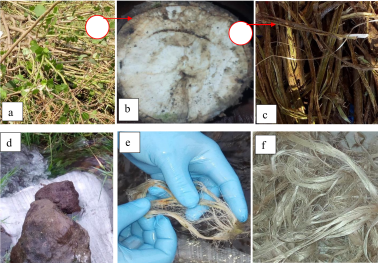
Figure 1. Illustration of the Urena Lobata fiber extraction process: (a) fresh UL stem, (b) UL stem cross-section, (c) UL stem bark, (d) UL fiber soaking, (e) UL fiber separation, and (f) UL fiber.
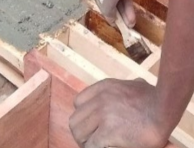
Figure 2. Oiling of the molds.
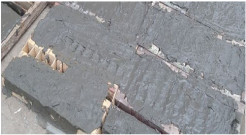
Figure 3. Molded samples.
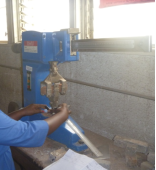
Figure 4. Flexural Testing Machine.
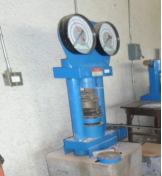
Figure 5. Compressive strength machine.
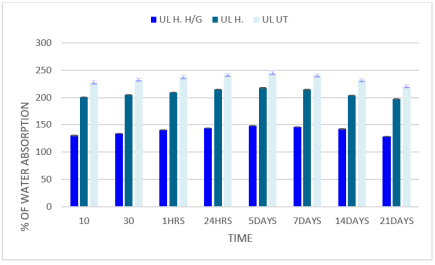
Figure 6. Percentages of water absorption of UL fibers.
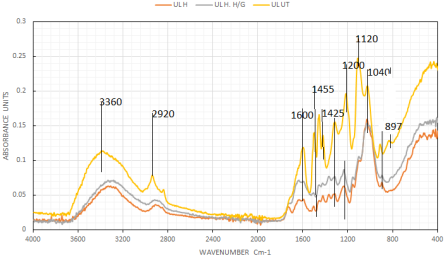
Figure 7. FTIR spectrum of UL fibres.
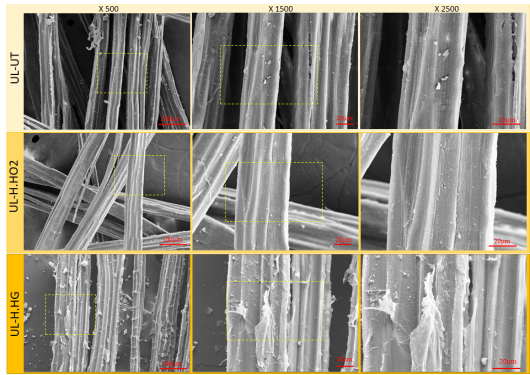
Figure 8. The SEM Image. (a) untreated UL fiber, (b) H. UL fiber, (c) H. H/G UL fiber.
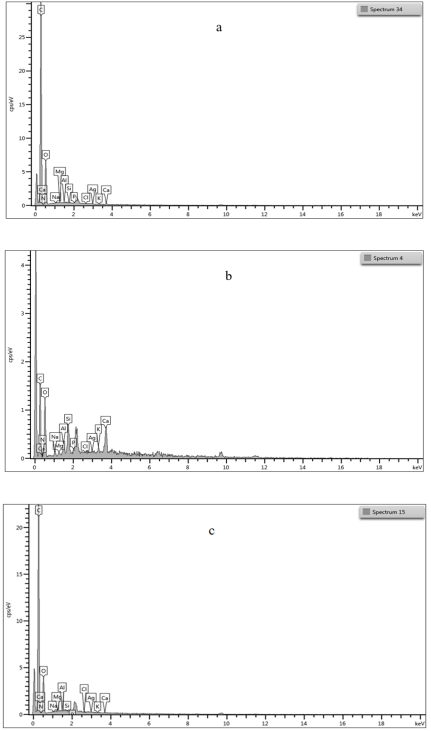
Figure 9. SEM/EDX results. A) Untreated UL fibers, b) conventional UL fibers, c) H. H/G UL fibers.
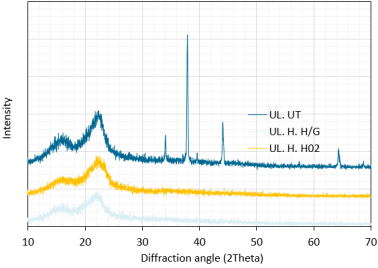
Figure 10. X-ray diffractogram of UL fiber.
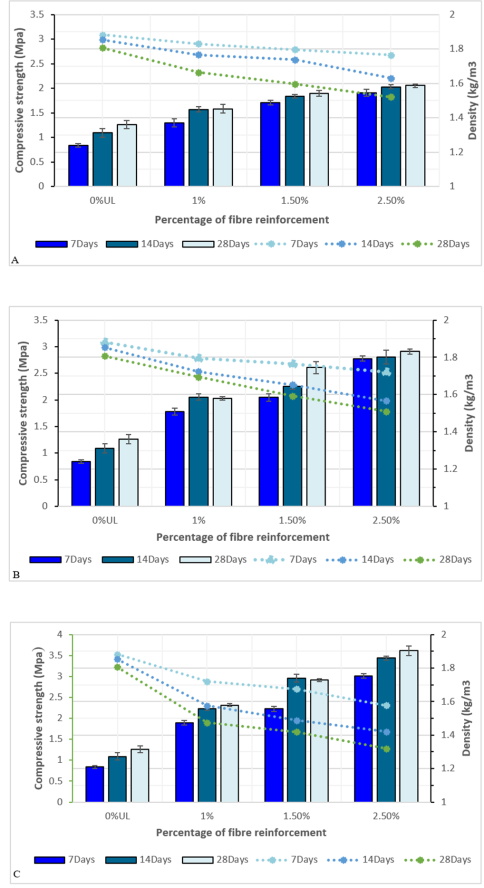
Figure 11. Flexural strength of different mixture proportions of fibers cement board after (a) UL untreated fibers composites (b) UL conventional fibers composites and (c) UL treated fibers composites.
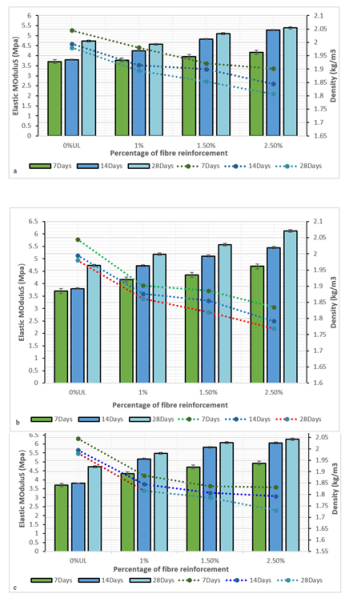
Figure 12. Compressive strength and Density of of different mixture proportions of fibers cement board after (a) UL untreated fibers composites (b) UL conventional fibers composites and (c) UL treated fibers composites.



 Share This Article
 Twitter
 Linked In
 Facebook
 Copy
Copy Download